Aka, how to make a fight easier than it looks.
For DMs learning to up their tactical acumen, read on. I’m going to talk about the most common combat encounter type, why it makes things easy, and how you can use that as a tool rather than as a default that might undermine your encounter.
(Players might want to avert their eyes from this post. Seeing how the sausage is made isn’t always a good thing.)
The Frontal Assault
The frontal assault pattern is the most common shape of encounter because it’s simply when one group of combatants happens upon another group, there’s some distance between them, and they fight. This is particularly seen in dungeons where monsters will be in a room and the players open the door to that room, triggering a battle.
This set up is so common, that I wonder if people consider its notice as worth of commentary. If you ask me though, to understand grid tactics, one must start by understanding the dynamics of this pattern. This is where it' starts. This is the fundamental.
First, though, we need a battlefield to talk about->
4 low-level players have tracked their targets to their lair. (If level 1, this is a deadly encounter.)
“The cave before you reeks of foul musk. As you peer into the darkness, you hear a low growl. It is joined by another, and another, and another. Soon, you see eyes glinting as they reach the thin line of light cast by the setting sun. The wolves emerge from their den. Their jaws drip with foam. Roll initiative.”
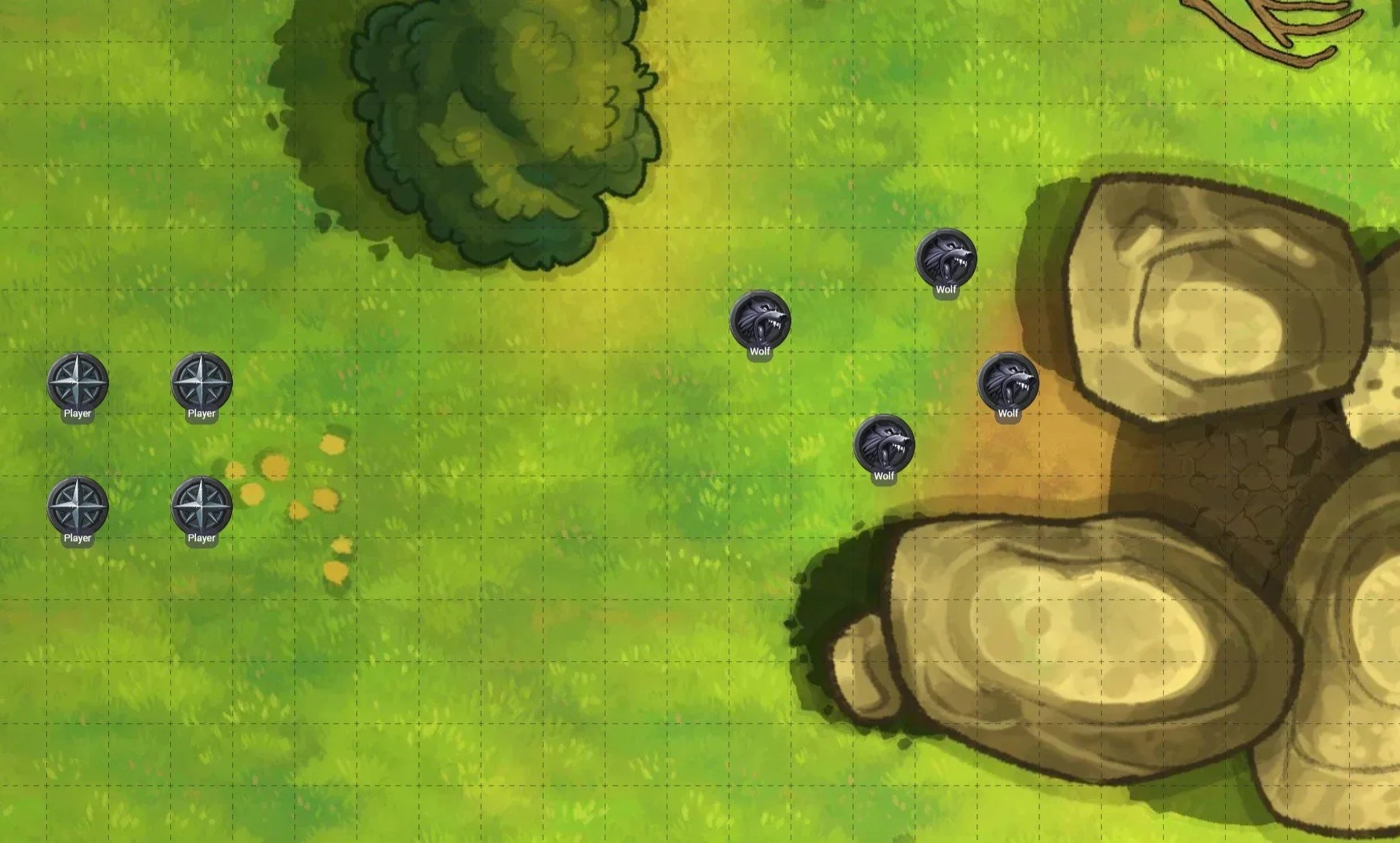
Battle at the Rabid Wolf den. The map was made in Dungeon Draft with tokens added via Owlbear rodeo so I could move things around easily.
Let’s start with the obvious - the rabid wolves are melee-only and pack hunters. As they are rabid, they are also suicidally aggressive. Therefore they will move for 2v1, 3v1, or 4v1 odds with their attacks and little else.
This is a very simple dumb-foe-rushes-you fight because this post isn’t about how to avoid hack-and-slash combat.
Now, despite this being a deadly encounter for level 1’s (using D&D 5e numbers) this arrangement ultimately favors the players because all their enemies are in front of them. How convenient!
For an example of how this plays out, let’s say the wizard and fighters roll fairly good initiative (map incoming.)
The Wizard casts Grease which knocks one wolf prone
The frontliners move up and focus fire on the lead wolf. (AC13, HP 11, it probably dies.)
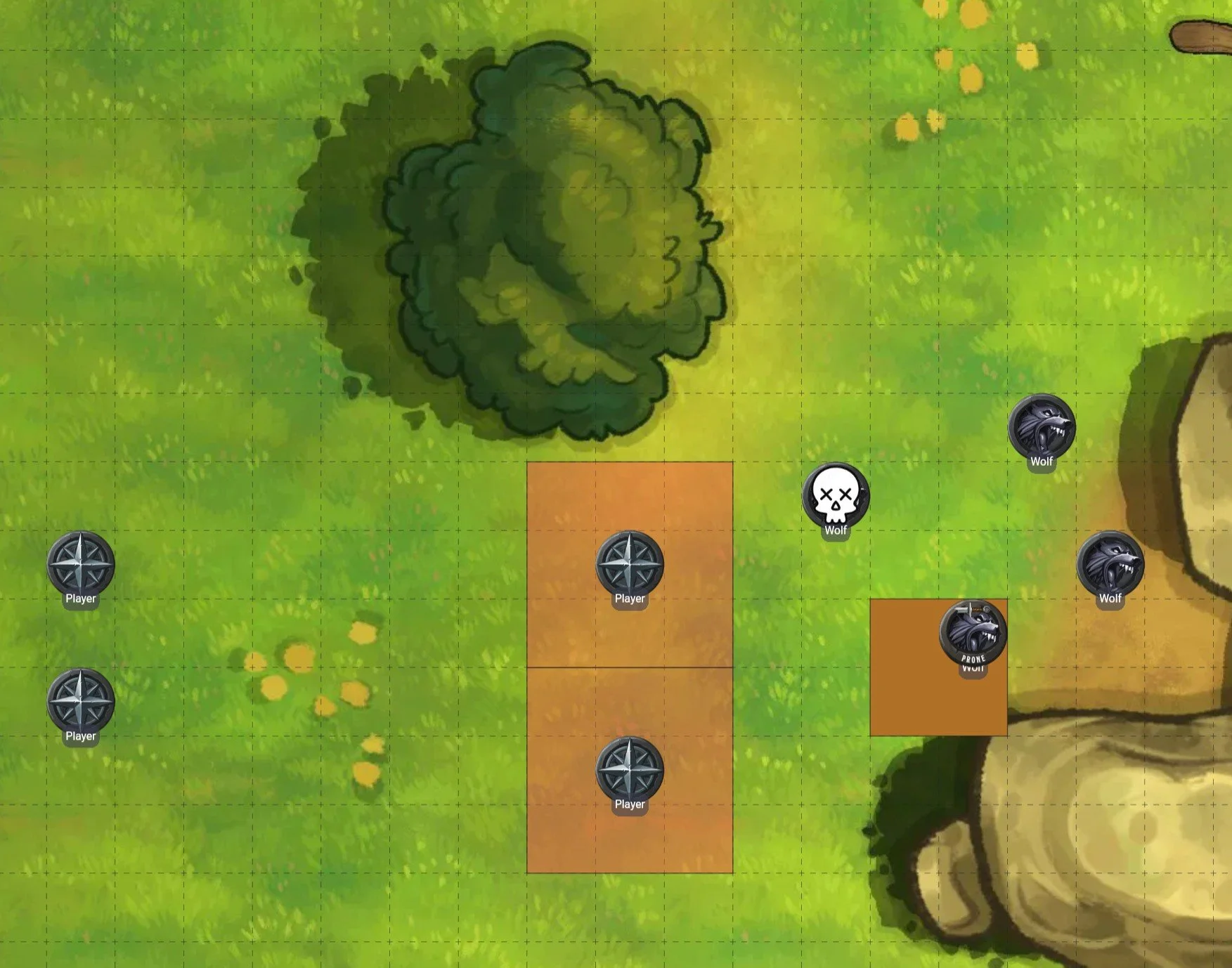
Brown square = grease.
Orange squares = zone of control for melee players (opportunity attacks.)
This fight is already over, to be honest. The prone wolf cannot stand, move, and melee a target this turn. The other wolves are channeled by the bush and the grease spell straight into the well-armored high-hp frontliner (maybe a raging Barbarian who takes half-damage) and they have no reasonable options to dash past the melee into the squishy backline.
On their turn, two wolves can only team up on the front-most melee player and maybe down him/her. Maybe. They might prone that player, but they are likely hitting someone with a STR save proficiency so…. it’s a bad bet. Maybe the TTRPG you’re playing is different, but little changes the fact that the wolves have been managed.
Then two more players can go, likely killing another wolf.
Round 2, we’ve two wolves left, but going by established initiative, wizard & frontliner can kill one
The last wolf is unlikely to do anything of consequence before dieing.
In the end, the players likely have one wounded frontliner and are minus a single spell slot for the whole “deadly” fight. Sure, the odds could tilt this against them, but overall it’s in their favor.
But what if the wolves go first? Well, then they have to waste a lot of actions on move & dash. Even if all the wolves go first, only 1 wolf can move & attack. The best they could achieve would be this positioning.
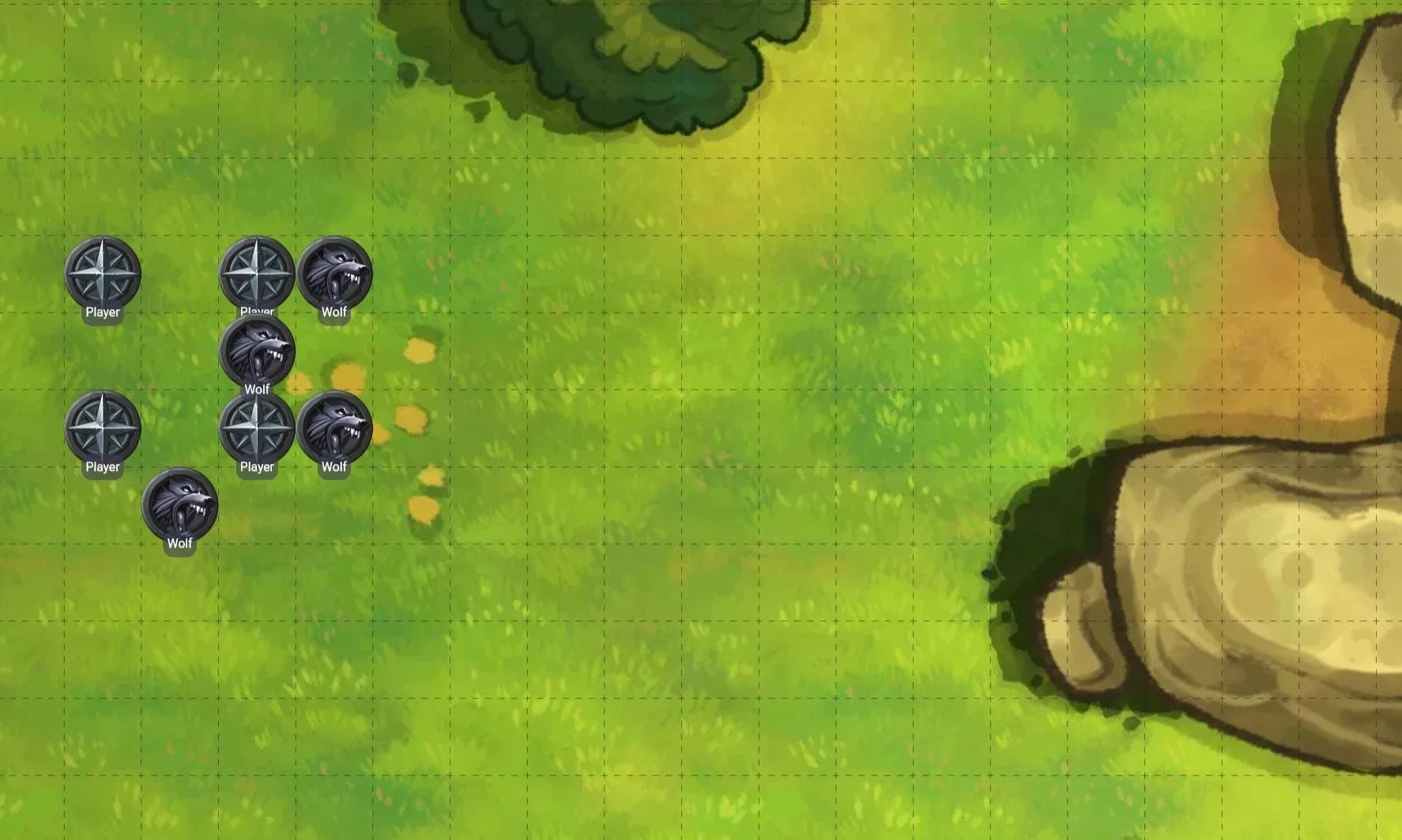
This threatens a lot of characters and sets up for a series of brutal team-up attacks BUT it’ll never happen. All four players now go. It’ll be pretty easy for them to kill the two wolves in the middle, leaving a clean front line and few options for the wolves.
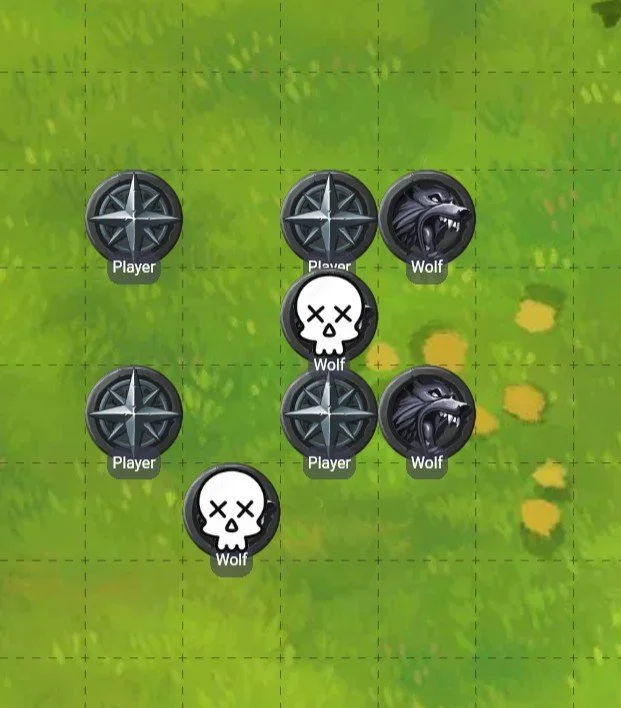
(Note: the two backline players would’ve scattered to make it even harder on the wolves.)
Again, this fight is effectively over, even if it was a deadly challenge. At best, you’re downing a single player who will likely revive via a healer’s kit or cure wounds before their first death save is even rolled. I guess that meets the “deadly” qualification but I doubt it will feel that way at the gaming session.
Anyway, there’s a million ways this fight could go, depending on luck, party composition, and player skill. That’s not the point. The point is that against a typical party who knows a little bit of tactics - this was not a dangerous battle. If it happened in a dungeon where there’s a doorway (choke point) then it’ll be even easier for the players to handle.
Why is this so easy?
When all the enemies are in front of them, players just have loads of options to deal area damage and/or control the fight. That’s honestly the crux of it. It’s just simple and all the enemies are conveniently located. In most TTRPGs, players outclass enemies when in comes to damage-dealing, ranged combat, and control effects. All of those factors favor dominating a frontal assault strength v strength situation.
Especially since, in most TTRPGs the DM cannot use the same control and focus-fire tactics in return because that would make the game unfun. (Wanna ruin a player’s night? Cast Hold Person, now they sit there for perhaps up to an hour IRL doing nothing except for maybe getting chewed on.)
“Fixing” the Frontal Assault
The frontal assault isn’t flawed, per se. It’s just simple. It’s just easy. If those features are what you, the DM, wants or needs, then those aren’t flaws and they don’t need to be fixed.
I really want to change up this encounter though to show you how simple positioning alters everything. Take a look at what happens if we change this up even a little. Here’s a partial-ambush-with-flanking situation.
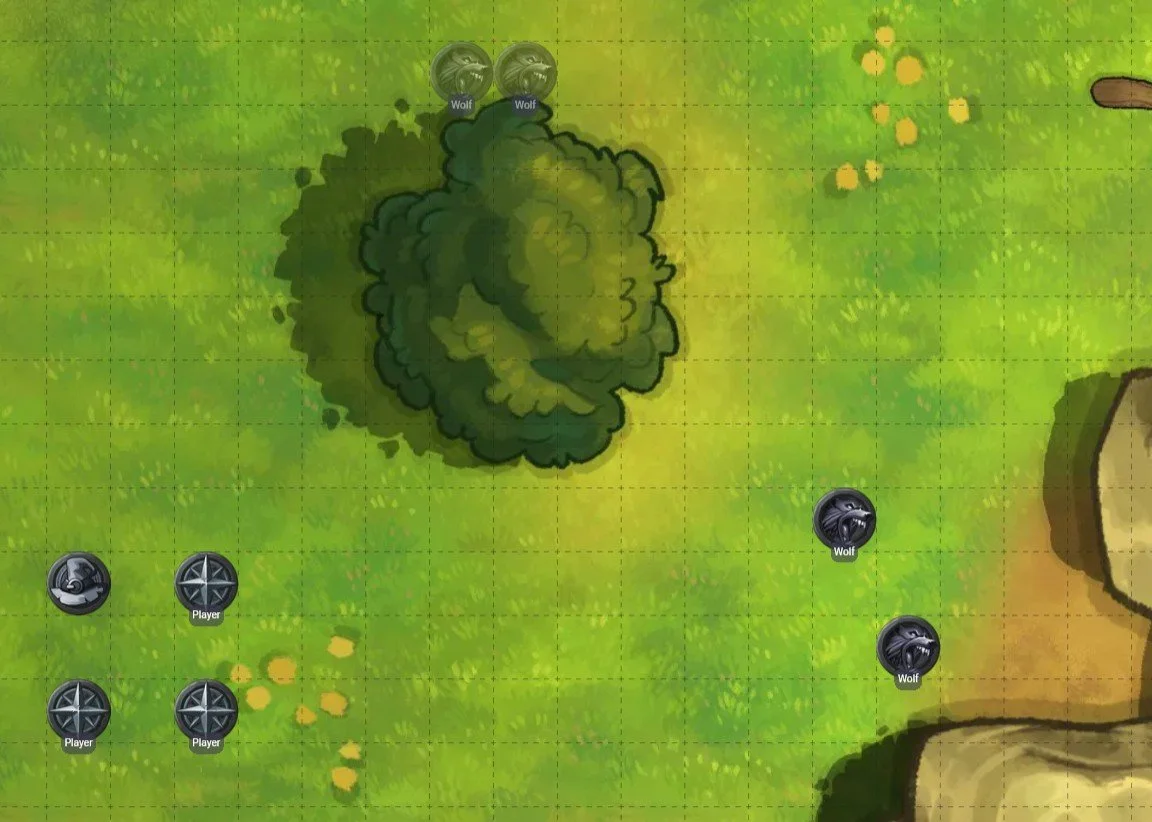
I’d stealthed two wolves north of the huge bush. Let’s assume the players didn’t detect them, so the party is oriented towards the visible threat of the two wolves by the den (with the den’s murky depths causing them worry about more.)
On round 1, the hidden wolves will break cover and double-team the wizard in the back. That’s certainly a first round down while the frontliners are going 2v2 with the other wolves. Once the wizard is out, backliner #2 is next. If initiative is lucky, the wizard drops before casting any control or area damage spells that could tip the fight.
(Btw, so long as the fight starts from these positions, the hidden status of the north wolves is largely irrelevant. They can wreck a squishy 2v1 no problem or they force the frontline to split along two fronts. This situation dilutes frontline power as well as area damage and area control options.)
Now that’s a deadly encounter! The players might barely stay ahead of the wolves in this situation. Do you see how positioning (and maybe a little stealth) changes everything?
How to use this pattern as a DM
Being able to control difficulty is a hugely important skill for a DM to have. Especially doing so on-the-fly as needed to keep the game interesting.
Let’s say you have a wolf ambush encounter planned but your players are proving to be tactically low-skill, or their teamwork is still gelling, or their characters (maybe level 2’s this time) are wounded/tired. Mid-session, they are barreling towards your wolf ambush encounter and you’re now worried about a TPK.
How can you make this easier yet realistic? Change up the encounter to a frontal assault pattern and hope it plays out like I showed you above.
There are other difficulty controls as well, such as removing 1-2 wolves, reducing their HP due to rabies, and so forth. Swapping from an ambush to a frontal assault is just one trick in your arsenal. It’s especially useful if you’ve previously told them “there are 4 wolves” and you are struggling to play it where it lays.
These kinds of DM techniques are also useful for subtly assisting players when they want/need to take on fights that are above their level and you don’t want to kill or TPK them.
How to not use this pattern as a DM
Ok, so plenty of new DMs wonder “why are my fights boring?” and “why are the players killing things so quickly?” This is not just an overpowered 5e problem. It can happen in any tactical battle TTRPG. Usually accidental overuse of the frontal assault pattern is one of the ways you end up there.
Frontal assault is often the default for combat. You can bumble into it. It’s like the air we breath and most combat scenario fantasies assume a frontal assault as well. It’s like the world bends around this thing.
Knowing that the frontal assault pattern exists and how it works is the key to using it well rather than having it undermine your planning. Hopefully I’ve given you that understanding today.
Thanks for reading,
I’ve been DMing for 30+ years and am really enjoying getting to talk about it online finally. I hope you found this post educational and I hope your players curse me for writing it and maybe sneak onto your computer to block my URL. That’d be a high compliment, haha. I’ll work towards it.
I have plans to write a whole series of DM War School articles, starting with the basic combat encounter patterns. Frontal Assault is the most common but there’s many others. The Pincer. The Ambush. The Flank. The Mix. The Cage Match. The Salient. The Enfilade. The Defilade. Fun stuff!
So please, stick around.
If you’re on Bluesky, please follow me. That’s how you get updates when I post here.