I want to show ya’ll one of my favorite tables. I call it, The Drama Engine and it’s perfect for creating interesting problems and secrets that players can chase. It’s also good for causing trouble, hehehe.
Here’s the pitch:
Have you ever had your players lock-in on a random NPC of no consequence? Or perhaps dig up an old one who’s arc is really done and there’s not much else going on in their life?
Do you need someone interesting right now?
Do you have no inspiration or ideas for such at this moment?
Do you have a player character who just doesn’t have much going on or much for you to work with?
Yeah, that happens to even the best of us. Especially since the DM faucet of creativity is often forced to work right now whether or not it has something. That’s ok though, cause a quality random table can help.
Read on!
The Drama Engine
Get yer dice out, cause without further mucking about, here it is,
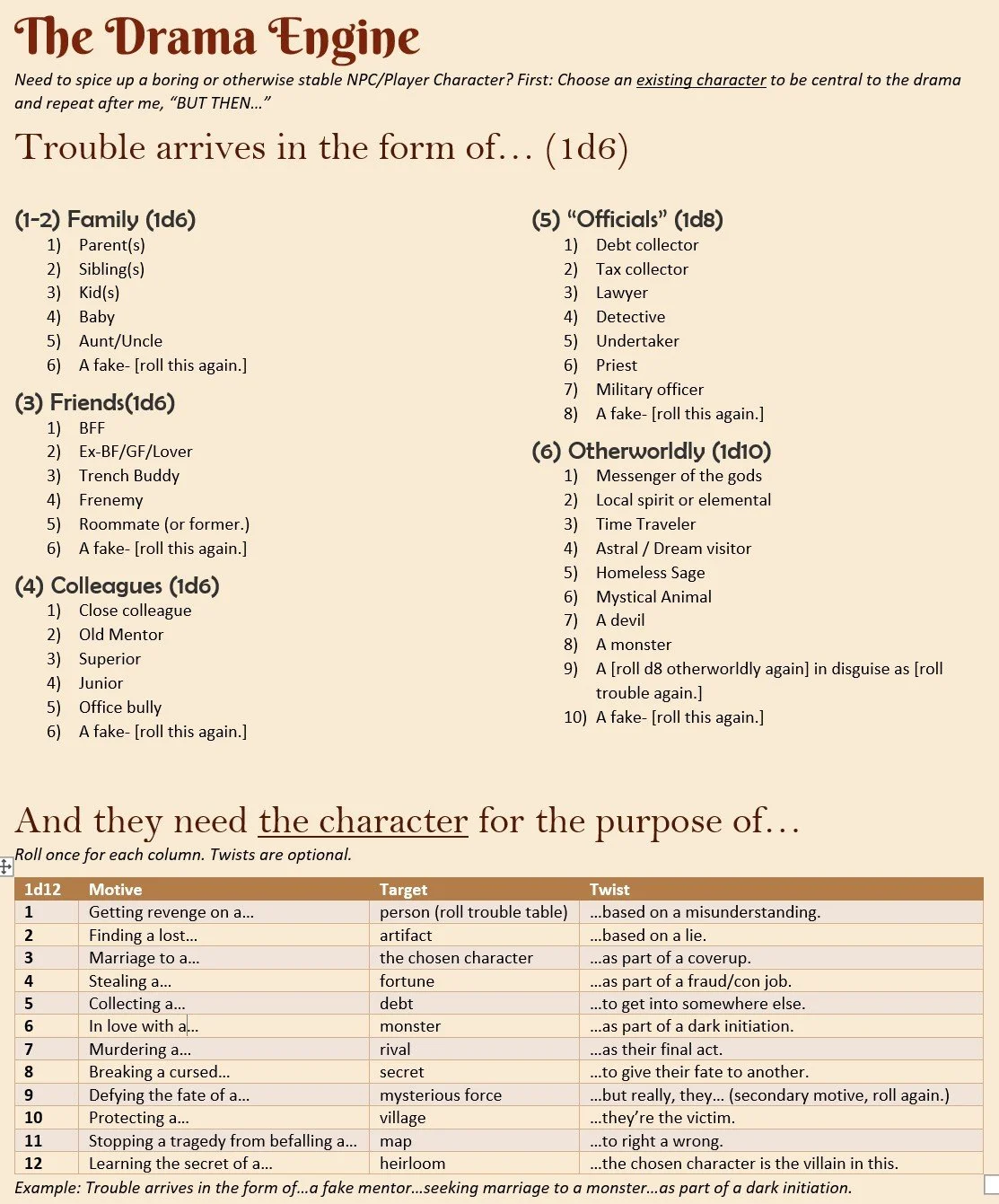
How to use: The Drama Engine
You pick a target character, either a PC or an NPC, whose life or backstory you want to spice up. This character is the center of the drama and I need you to assume that whatever gets rolled up is personal to them somehow. I cannot stress “personal” enough.
ALL DRAMA IS PERSONAL. This is a rule of all entertainment be it books, tv, anime, or TTRPGs. Even the drama of an empire is reduced to people and their lives and how those lives affect the nation. If you want amazing drama, then what’s happening must always be personal to someone. Ideally it’s personal to a player but it’s just as functional if there’s an NPC the players all know for whom the drama churns.
Personal means that the character can’t just ignore this problem. Why? Because they care. Because it’s personal. It’s their friend, their mentor, their father, their lover, their brother, their god, etc… If the character can just turn their back on the problem then you haven’t set up the problem well enough. Though, I’ll admit, with players this is a crap shoot as they are the final arbitrator of what they care about. The DM can only try. NPCs though? Just assume that they care and you’re gold.
An example of: The Drama Engine
The Character: Bob the Silver Dragonborn Fighter, he likes to fight. Level 12, let’s say. He has a big sword, min-maxed stats, and little else going on.
Let’s roll up some spice for Bob’s life. Some personal spice.
It looks like a Fake Baby has shown up on Bob’s doorstep!
Haha, ok, this gives me a Mandalorian vibe and let’s assume that we know that Bob’s player is a fan of the show and would be down with this plot thread for at least a little while. If not, perhaps reroll and choose something else. Knowing your players is on you, the DM. I’m just an internet guy, making up internet examples.
So, let’s say that the baby looks like him and there’s a note, “They are after me! Please bring your baby brother to Heartwood Village, he’ll be safe there. -Mom”
INSIGHT DC 16: The baby gazes at you with watchful eyes.
Why yes, this is totally sus. Cause the Fake Baby is actually an adult silver dragon shapeshifted into such. The real motive here is defying the fate of a village as their final act. It’s all a lie to get Bob to smuggle this dragon into a doomed village, thus embroiling him and the entire party in a dragonic plot that ultimately ends in the silver dragon revealing itself for a grand sacrifice moment to save everyone (and I’m assuming the players will save the dragon, which would make for a happy ending.)
This is a plot hook that triggers RP about Bob’s family as the players will all suddenly have questions. Which will in turn encourage development of his backstory. His mom should absolutely be party to the dragon’s scheme so Bob should be able to find her at some point and have a talk.
A 3-Step Plan
We generated the hook+setup, but now what?
When working with single-thread character-specific dramatic elements like this, I like to use a rule-of-three-moves. That’s simply a bulleted list of the 1-2-3 for this mini-plot to make sure that it moves quickly and ends finitely.
For Bob, I’d just write down,
The mysterious baby! (investigation, hints, the mom)
The baby is a dragon (the water is deeper than we thought.)
The dragon is going to die (but, we’re buds now!)
Those are the big beats I want to hit as the players (1) investigate the baby situation and then transport it to the village, followed by (2) getting into whatever trouble lurks at/beneath the village, and ending in the big reveal of (3) the dragon is going to sacrifice itself to save everyone.
(Btw, there’s a huge dramatic question of “why would an adult dragon need to be smuggled into a town?” Make sure to have a cool answer for this.)
The rest? I’d plan that session-by-session but it’s up to you. Prep as much or as little as you want. The point of all this is that you’ve given Bob a plot, which develops him, which hooks the party to whatever direction you want them to go, which has a finite conclusion. If they save the dragon, then maybe Bob has a connection to it now and is more of a person to boot.
Drama Engine+1
So, that’s the drama engine and it’s basic uses. I’ll leave off here with one more trick. You can roll this up and then keep it a secret.
Say you need to spice up random merchant #231. Roll roll roll, looks like he’s plotting to steal his rival as part of a coverup. Haha, now we have one of the town’s merchants working to kidnap his rival because his rival saw something.
Town deeeerama! If you designate this as a secret, then drop hints or clues to the players, and maybe have some odd events foreshadow things then you now have a mystery. An active one that’s on the move. Good fun and it makes the town more alive to boot.
Anyway, that’s what I have today. Have fun trolling your players!